
Full Summary: Kaika's Songs, by Mohammed AlModhayan
Kaika's Songs is not a book that tells you what to think. It is a book that watches you think. Mohammed AlModhayan, a Saudi novelist wrote his debut novel and this is the full summary and analysis of our book of the month

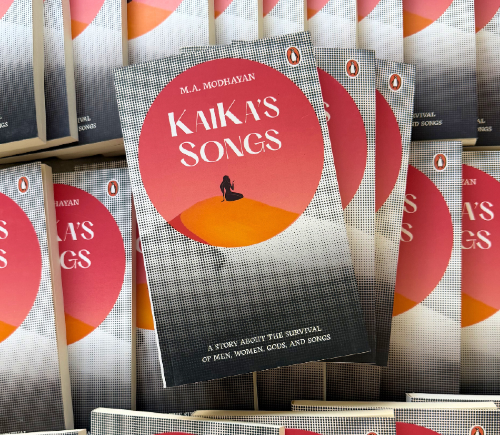
Al Jalees’ book of the month for May is a literary fiction novel with profound philosophical themes, penned by Saudi novelist Mohammed AlModhayan. As we eagerly await the event on the 6th of May, we prepared this full summary and analysis for you. Click here if you want a free copy of the book, graciously gifted by the author for our community.
Kaika's Songs is not a book that tells you what to think. It is a book that watches you think. Mohammed AlModhayan, a Saudi novelist who first wrote Kaika's Songs in English and then rewrote it entirely in Arabic not translated, but rewritten from the ground up into a version four times longer and considerably more poetic; does not consider this a fantasy novel, regardless of how it may be shelved. He calls it literary fiction or philosophy. It is a book that resists every category you try to place it in, and that resistance is not accidental but the whole point.

What you bring to this book is what the book becomes. A reader drawn to politics will find a story about power; who holds it, who loses it, and what it costs everyone around them when it changes hands. A reader drawn to questions of family and inheritance will find a story about mothers, loyalty, and the strange, heavy things we carry from the people who raised us. A reader drawn to faith or to the absence of it; will find something that quietly and without announcing itself invites them to sit with questions they may not have expected a novel to raise. The author has said as much: there is no single correct reading of this book. Readers interpret it through the lens of whatever matters most to them. That is not a flaw in the design. That is the design.
The first two chapters are dense and immersive, and they are meant to be. The world-building that fills them is the foundation of what follows. Readers who stay with those early chapters arrive at a world that somehow starts to make sense, governed by its own laws and its own logic, and they carry questions from it long after the last page.
The World
The story takes place on Sand Island, a place completely cut off from the rest of the world and surrounded by an ocean that has swallowed every islander who ever tried to leave. There is nothing beyond the water to swim toward, and the ocean does not behave like a neutral boundary but like a warden, using its waves to lash and warn anyone who comes too close to its edges. At the heart of the island stand two enormous granite mountain beds, one confused between shades of red and brown, the other a certain shade of grey, both shattered and scattered across white dunes filled with ancient seashells and bleached coral. The five islanders who are still alive live four flights underground, in dark caverns that smell of urine and excrement — a smell that is, by this point in their lives, more comforting than the open air, because out in the open is where Sand lives.
Sand is the god of this world, and it governs everything: who eats, who starves, who leads, who serves, who is born, and who dies. Time stops when Sand arrives and moves again only when Sand decides to release it. The islanders' entire civilization; their food distribution, social hierarchy, water rituals, laws and their sense of justice has been built entirely from songs that were originally sung out of terror. Stop singing and Sand wakes. Wake Sand and people die. Fear is the foundation, and everything these people have built on top of it like their solidarity, tenderness toward one another, their sense of meaning in an otherwise merciless existence is real precisely because of how hard it was to build and how much it costs to maintain. The book does not judge this arrangement. It is honest about it, and in being honest, it asks us to be honest too.
The Five Islanders
KaiKa is the tribe's leader, and she carries that role the way someone carries a wound that has healed slowly. She’s present in every movement and shaping everything she does. From managing the hunt with the precision of a conductor to distributing food with the calculated deliberateness of a politician to keeping the songs alive at all costs because she understands, more deeply than anyone, that the songs are not just ritual. They are the only thing standing between her tribe and Sand's indifference. She is also the book's most morally complex figure. She ate the flesh of AiYi's mother during a starvation feast, and she has never been able to put that down. Her deepest aspiration is not power but to be as morally deliberate as her mother.
LaKhi is physically gifted, emotionally open, and the kind of person who slows down at the back of a dark cave procession to make sure no one slips not because he has been asked to, but because it does not occur to him to do otherwise.
SeeKa is impatiently selfish and deeply in love with LaKhi, and she steals from the weakest member of the tribe and gets bitten for it yet none of these characteristics in the book present her as villain but pure hunger. More so like the behaviour of a starving person grabbing at whatever she can in a world that gives people almost nothing to hold onto.
NooaKhi is precise and physically formidable, the one who always comes back from a hunt with the most food, the one who is first to carry AiYi on his shoulders and first to seal the cave entrance when a sandstorm arrive and yet he cannot sing, which in a civilization where song is the constitution, the currency, and the law, is a devastating thing to be unable to do. He is the most dangerous member of the tribe and, in some ways, its most desperately loyal member.
And then there is AiYi, the little blind girl who follows KaiKa everywhere. In the light of day, she is the tribe's stray pet, small and dependent, navigating the world through scent and voice because she has no other tools available to her. In the darkness of the cave, she transforms entirely by swinging from rock to rock like a hummingbird, leading her tribe through passages she has mapped from pure memory using ocean wave echoes and the texture of sand beneath her feet, becoming in those dark hallways the shepherd to everyone else's sheep. When she was a toddler, she crawled out alone during a sandstorm and a mad, starving father found her sleeping in the dark, lifted her by her head, placed his lips against her face, and sucked her right eye from its socket. Before the mothers could reach her through the cave's darkness, another hungry father had taken the second. Her mother held her through the rest of that storm, singing the most beautiful song of thirst she had ever sung — an aria that Sand itself heard and was satisfied by. AiYi healed but unfortunately blind and terribly scarred, and she has kept a secret ever since: a song of gratitude that she has hummed only inside her own head since childhood, afraid that KaiKa would not allow it.
What Happens
The novel opens with five people trapped in total darkness during a sandstorm, and it builds slowly from there through the relationships, the histories, and the intricate social architecture of Sand Island so before the plot accelerates into something that none of the early chapters prepare you for, at least not fully.
The first great rupture arrives when SeeKa is found to be pregnant, the last fertile woman on the island. The tribe responds with something close to joy, and her survival immediately becomes the group's most urgent priority. But in the same stretch of the story, NooaKhi; who has stopped singing entirely, which is a radical and dangerous act of defiance in a tribe where song is law crosses a line that cannot be walked back from. KaiKa attempts to reach him through three different songs: the song of hope first, then the desperate song of mercy, then hope again. NooaKhi responds by tightening his arms around her throat and holding her face down in the water pond until she stops moving. His first and only unspoken law has been stated: sing, and die.
What follows is the novel's long, quiet second movement. Without KaiKa's songs, time stops on Sand Island, because song is how time is measured and shared among the islanders. The island itself seems to respond to her death: it rains for the first time anyone can remember, freshwater appears everywhere, crabs and plovers and dragonflies arrive on shores that have never seen them, and the island begins to bloom green. NooaKhi governs the survivors with surprising calm and an unexpected generosity. A boy is born. And then AiYi, alone on the beach one afternoon, finds a conch shell, holds it to her ear, and feels KaiKa's presence move through it. She does the one thing she has never allowed herself to do: she sings her secret song of gratitude out loud. NooaKhi beats her for it. A sandstorm arrives. He chokes her into the sand. She bites through his fingers to the bone. The storm takes them both, and AiYi does not survive it.
She wakes in a hidden chamber high on the island, and she wakes with eyes. Waiting there she found a very old man who is ancient and round-bellied, imprisoned in that chamber for thousands of years — who has been watching every islander who ever lived on this island, without being able to intervene in any of it. He is the island's keeper, its god of sorts, but not by his own choosing. He was tricked into inheriting the role from a long and unbroken line of equally trapped, equally lonely men who came before him. He tells AiYi everything: the sandstorms have never been random weather that they are punishments, the consequence of a covenant made long ago with MaSi, the ghost of a murdered man. Every islander who ever sang from the heart, who carried genuine goodness inside them, was sent through a portal in the chamber wall to the Evergreen Island of Eternity. Every wicked one was transformed into a Sand monster, sentenced to rage forever. The old man is dying, and as he dies, Sand is dying with him. And the young woman AiYi saw stepping through the portal when she first opened her new eyes, she had the motherly smile and the tear-filled gaze standing was KaiKa.
The Ending
AiYi returns to the world of the living as a ghost carrying sight she did not have before, a voice she never dared use fully, and a song of truth that the island itself delivered through her. She brings it separately to LaKhi and to SeeKa, hoping to save them both. SeeKa receives it in a dream and understands everything it is telling her but she chooses silence, deciding that protecting her son matters more than any song. LaKhi receives it in a different way entirely: he falls to his knees and sings the song of guilt out loud, into the open air, without hesitation.
The song of guilt summons the final storm. NooaKhi rises from within the sand. The tornado descends on LaKhi, SeeKa, and their infant, and the three of them cling to each other as Sand fills the air around them and begins filling their lungs. The old man, drawing on what remains of his power through the force of LaKhi's singing, opens the portal one last time. AiYi refuses to pass through it until SeeKa and her son go first, and she stands her ground in the storm while the portal holds open. SeeKa goes through. The baby goes through. LaKhi goes through. And then AiYi turns to the old man who cannot see his own face and has never been able to and she describes it to him: the sad smile she trusted from the beginning, the eyebrows that could not hide his sorrow no matter how he arranged them, the round cheeks that forced his eyes into a squint whenever he smiled. She kisses him. She says goodbye. And she pushes him gently through the portal before it closes behind him. The tornado stops. The island goes quiet, whole, and entirely empty.
The final chapter belongs entirely to AiYi. She becomes the island's keeper and not its prisoner, as every keeper before her had been, but something altogether different. She roams it freely, dives into the ocean without fear of being swallowed, guides sea turtles through the shallows, listens to whale songs from beneath the surface, and walks through swarms of bees with her ear pressed against their bodies to hear their hearts. Over the course of four hundred summers, the island grows into something extraordinary: mangoes, coconuts, papayas, butterflies, frogs, palms, a full and thriving world that has never existed on this island before. New settlers eventually arrive by boat. And when the first ghost comes to her lost in the dark, uncertain, as all ghosts are. AiYi offers what no keeper before her ever offered: a real choice, made freely, without fear and without a trade. A tree, she tells the ghost. An ocean. A drop of water in the sky, becoming a cloud, travelling beyond the moon and the stars. The woman chooses to fly. AiYi claps her hands. The ghost dissolves into the island. And the cycle begins again, but this time with someone in charge who was never afraid of the dark.
What the Book Is Really About
Kaika's Songs is not, at its core, a story about survival though survival is everywhere in it. It is a story about what survives inside the people who survive: what they carry, what they bury, what they pass down without meaning to, and what they protect at the cost of everything else. It is a story about the origin of belief how fear builds faith, how faith constructs society, and what happens to both when the god they were built around begins to weaken and disappear.
The sandstorms in this book are not metaphorical weather. They are the consequence of a civilization that invented a punishment system in order to make meaning out of death, to find justice in a world that offered none on its own. The songs are not rituals in the decorative sense, they are a constitution, a legal code, a shared language, a form of collective therapy, and the only infrastructure a group of people has to hold themselves together when everything around them is designed to take them apart.
The book's greatest revelation is not NooaKhi's violence, as shocking as that moment is. It is AiYi. The character introduced as the most vulnerable person in the tribe who's blind from toddlerhood, unable to protect herself, carried and fed and kept alive by the decisions of others eventually turns out to be the one who was always most deeply connected to what the island actually was. She was the one who carried a song no one else was permitted to hear. She was the one who navigated the darkness with greater ease and confidence than anyone who could see. And she is the one who ends the novel not as a god, not as a martyr, but as a keeper who chooses, for the first time in the island's long history, to offer those who come to her something real — a choice made without fear attached to it.
She spent her entire life in darkness, without eyes, learning the world through the sounds of waves and the texture of sand beneath her feet. And she was never, not once, afraid of the dark. That is what makes her the right person to inherit the island — not power, not prophecy, but the simple and extraordinary fact that she was already home there.