Koorsoo: A Faint Glimmer of Hope
Global theme of the month at CreativeMornings is Koorsoo, which means hope, and Al Jalees explores the meaning from a literary lense.
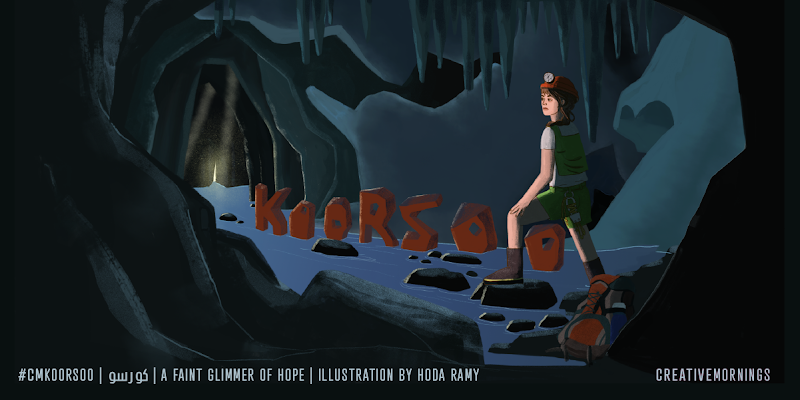
With Al Jalees Culture Club and CreativeMornings Riyadh, each month begins with a single word. This January, that word is Koorsoo: a Persian word chosen by the CreativeMornings Tehran chapter, meaning a faint glimmer of hope.
Hope is a small quiet light that survives when we feel unclear. This might sound simple, but when we slow down and sit with it, the word opens something deeper especially in a world defined by urgency, anxiety, and constant pressure on decision-making.
In the session, the image of a chair was used as a metaphor to explore the theme of Koorsoo. A chair can represent rest and grounding, but also hesitation. The moment of sitting with uncertainty before deciding whether to move forward, or to stay. At the CreativeMornings Riyadh session, Koorsoo became a lens through which we explored decision-making, anxiety, and hope as lived, human experiences.
Speaker Spotlight: Dalia Khan
What made this session stand out was Dalia Khan’s approach.
She did not frame decision-making as a productivity skill or a leadership hack, but as a deeply human process shaped by fear, emotional load, and meaning.
Early in the session, Dalia invited the audience into a simple exercise:
stand or sit based on small preferences, like tea choices. The point wasn’t the choice but how quickly we made it. Dalia mentioned that many of our daily decisions are not made because they are right, but because they relieve tension.
Under stress, the brain’s fear center — the amygdala — takes over. For some of us, that means freezing. For others, it means constant movement. Action becomes a way to escape uncertainty, not resolve it. That reflection resonated deeply with many listeners — myself included — constant motion doesn’t always lead to clarity. Sometimes, it’s avoidance as a coping mechanism.
Hope as a Framework
The conversation then moved toward hope, not as optimism, but as structure.
Drawing on psychologist Charles Snyder, hope was described as having three elements:
- a clear goal
- a possible pathway
- internal motivation to keep going
Hope, in this sense, is not wishful thinking. It’s direction with meaning. Dalia then contrasted this with Viktor Frankl’s perspective: hope as endurance.
The ability to accept reality as it is, and still choose meaning within it. In that framing, hope isn’t about knowing the outcome, but about staying present without guarantees. Koorsoo, then, is not about clarity. It’s about continuing anyway.
A Personal Story of Sitting With Uncertainty
Dalia shared her own journey of leaving an academic path and entering a completely different professional world, a decision that wasn’t immediately understood or supported by her circle. What mattered wasn’t validation, but internal alignment.
That moment opened the room. Many participants reflected on staying in jobs, projects, or paths that no longer held meaning. The fear of “wasted effort” keeps many people seated in the wrong chair.
Koorsoo invited us to ask:
Why am I choosing this?
Sometimes, the bravest thing is to take a moment of silence, to reflect inward, and to listen to our hearts. Sitting still is not weakness; solitude is sometimes healing, and it reveals the truest paths we are meant to take.
The Literary Thread: Hope in Words
Literature has always been the refuge to escape to when in doubt. It behaves as a warm embrace to our uncertainty.
“In our darkest hours, when everything seems to have dimmed, sometimes a light remains — not bright, not certain, but real.”
— CreativeMornings Tehran, Koorsoo
“When we are no longer able to change a situation, we are challenged to change ourselves.”
— Viktor Frankl
“Yesterday is history, tomorrow is a mystery, today is a gift of God, which is why we call it the present.”
― Bill Keane
Suggested Books
1- The Boy, the Mole, the Fox and the Horse, by Charlie Mackesy
Read this book because it speaks in the language of reassurance without denying pain. Hope here is not loud or triumphant; it is quiet, tender, and allowed to exist alongside fear, sadness, and doubt.
2- A Man Called Ove, by Frederik Backman
Read this book because it shows hope where it seems least likely to exist. Ove’s resistance to life is precisely what makes his return to it meaningful. The book reminds us that hope does not always arrive as optimism — sometimes it arrives as routine, responsibility, irritation, and an unwillingness to give up on others, even when one has given up on oneself.
3- Letters to a Young Poet, by Rainer Maria Rilke
Read this book because it reframes hope as something quiet and internal, not something that demands certainty or resolution. Rilke doesn’t promise clarity; he asks us to “live the questions.” In a world obsessed with answers and outcomes, this book offers a different kind of hope — one rooted in endurance, inner growth, and faith in becoming, even when the path is unclear.